
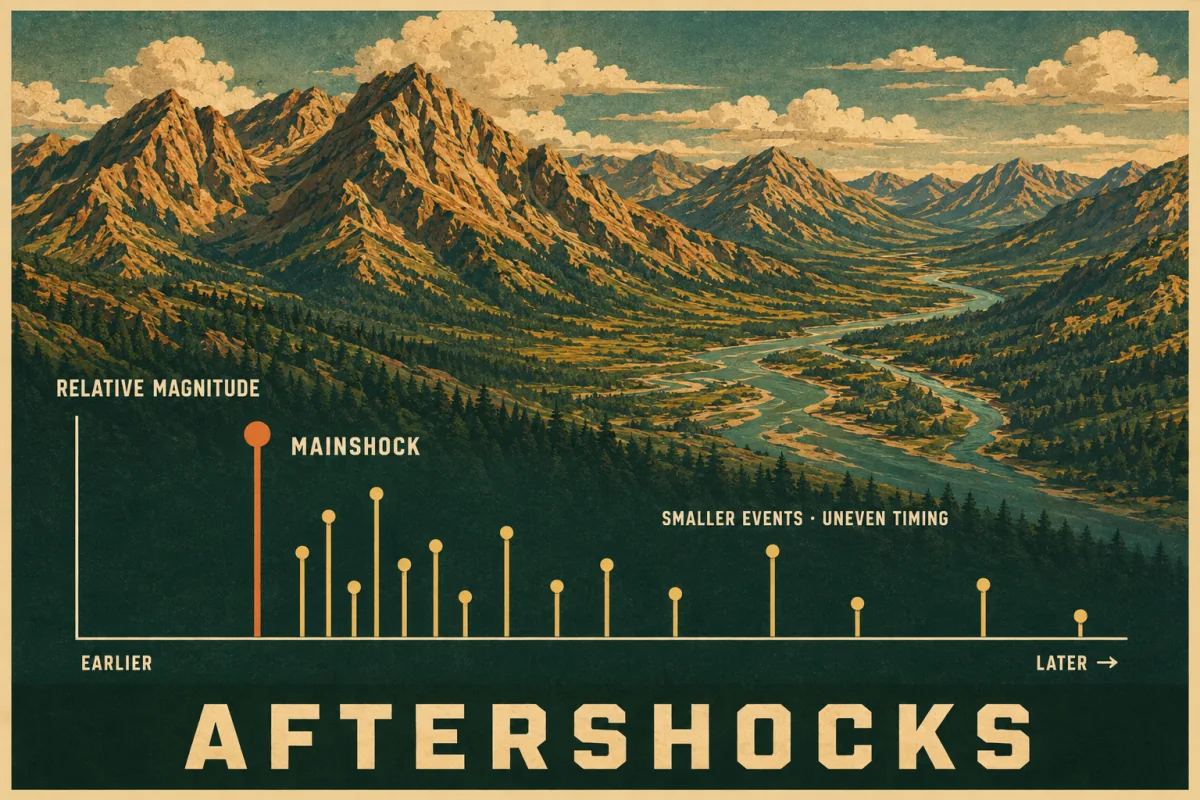
Aftershocks are earthquakes that follow a larger earthquake in or near its rupture area. The largest event in the sequence is called the mainshock. As the crust adjusts to changed stresses, further faults or parts of the same fault may slip.
Three terms that describe a sequence
- Mainshock
- The largest earthquake in a sequence.
- Aftershock
- An earthquake that follows the mainshock nearby and is smaller than it.
- Foreshock
- An earlier earthquake identified as part of a sequence after a larger event occurs.
Those labels can change as a sequence develops. If a larger earthquake follows, it becomes the mainshock, and earlier events can be reclassified as foreshocks. Calling something a foreshock generally requires hindsight.
How long do aftershocks last?
Aftershock activity usually becomes less frequent with time, but it does not end on a fixed schedule. Sequences can continue for days, months, or years, depending on the mainshock and the region. A quiet period in a short earthquake list does not establish that a sequence is over.
How is a swarm different?
A swarm is a sequence without one clearly dominant mainshock. On a map, both swarms and aftershock sequences can appear as clusters. To distinguish them, scientists examine how events relate in time, location, and size, along with the local geology.
Read a cluster without overinterpreting it
In Explorer, select several nearby events and compare their times and magnitudes. Then change between the last 24 hours and the last seven days. This helps reveal how much of the pattern depends on the chosen time window.
The displayed events come from a magnitude-limited feed. Small aftershocks may be missing, especially outside well-monitored regions. Explorer does not label individual events as mainshocks or aftershocks, and a cluster alone is not an earthquake prediction. Follow the USGS event links for the reporting agency’s analysis.
Sources & further reading
- USGS: What is the difference between aftershocks and swarms?
- USGS: Aftershocks? Swarm? What is the difference, and what do they mean?
By Josh Clemm · Reviewed September 5, 2026. Educational information from Earthquake Alert; no earthquake early warnings.